
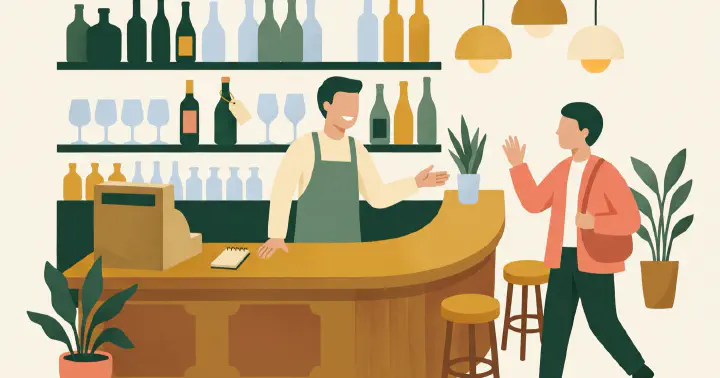
The moment a regular walks through the door and hears, “Welcome back — the usual, right?” — that one sentence changes the whole atmosphere of the evening. And the opposite: you recognize the face, but you have to ask, “Um, what do you usually drink?” — that tiny flicker of awkwardness. If you work at a bar or a club, both moments will feel familiar.
We tend to think of “good service” as a warm smile, attentiveness, or skillful conversation. But what relationship research shows is that what stays with people isn’t “technique” — it’s something much simpler.
“Perceived Partner Responsiveness” — the feeling that the other person understands you, accepts you, and cares about you. In a 1998 study, participants kept a diary right after each interaction for one or two weeks, and the researchers tested what creates intimacy. The results were clear: alongside mutual self-disclosure, the more people felt their partner’s responsiveness in an interaction, the greater the intimacy. And in the second study, sharing “emotions” predicted intimacy more strongly than sharing facts.
Move this to the counter of a bar, and it is the very science of “the usual, right?” Remembering the kind of bottle someone keeps, or their karaoke signature song, isn’t a display of memory. It works because it is evidence of responsiveness — “I see you,” “I remember what you told me” — and that is why customers feel “I matter here, I’m special here.” The same goes for asking, when someone comes back from a February trip to Hokkaido, “How was the Snow Festival?”
A US restaurant-industry survey found the same thing: 48% of guests said what makes them feel most valued is not points, but being remembered — their name, their usual order — while only 30% said they actually experience it all the time (Toast/Resy, “The Regulars Report,” 2026, survey of 1,500 people conducted April 2, 2026). Being remembered is still a “special experience.”
Of course, this study was diary research on everyday interactions in general — it did not test hospitality at bars directly. Nor does it prove a causal link, that taking notes will always gain you more regulars. But the direction it points to — that the act of “remembering” nurtures the other person’s feeling of “being valued” — applies directly to the front line of hospitality.
Things you can try today: 30 seconds before they arrive
- Before a customer arrives, take just 30 seconds to glance at their notes. Hold in mind one thing: their bottle, how they drink it, the topic you were going to ask about next.
- In conversation, touch on feelings rather than facts. Not “So you went to Hokkaido,” but “Did you enjoy the Snow Festival?”
- When they leave, leave them a line for next time. “Next time, tell me the story about the big fish” — and that becomes the promise of the next visit.
Sources:
- Laurenceau, J.-P., Barrett, L. F., & Pietromonaco, P. R. (1998). Intimacy as an interpersonal process: The importance of self-disclosure, partner disclosure, and perceived partner responsiveness in interpersonal exchanges. Journal of Personality and Social Psychology, 74(5), 1238–1251. DOI: 10.1037/0022-3514.74.5.1238
- Toast / Resy, “The Regulars Report” (survey of 1,500 people conducted April 2, 2026) https://pos.toasttab.com/blog/data/regulars-report